
What Do Pest Control Companies Actually Do on a Service Call?
Quick Answer
On a service call, a pest control technician inspects your property, identifies the pest and its source, explains the treatment plan, applies registered products in targeted spots, and gives you advice and precautions. For established problems, they’ll arrange a follow-up. It’s a methodical process — inspect, identify, treat, advise — not just a walk-through with a spray can.
If you’ve never had professional pest control, it helps to know what to expect on the day. A proper service call follows a clear sequence, and understanding it makes it easier to judge whether a company is doing the job right. Here’s what actually happens.
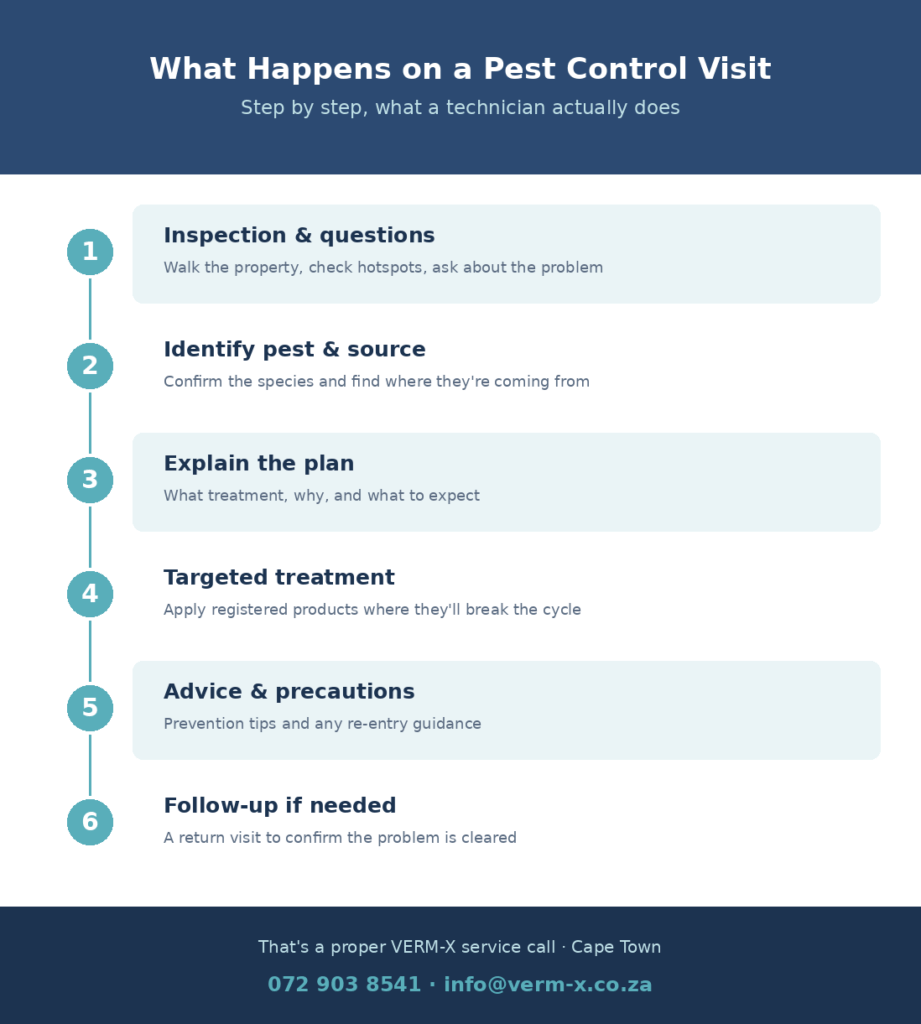
“What Happens on a Pest Control Visit”.
1. Inspection and questions
The technician starts by walking the property and asking you about the problem — what you’ve seen, where, and for how long. They’ll check the likely hotspots: kitchens, bathrooms, roof spaces, skirtings, entry points and damp areas. This first step gathers the information that everything else depends on.
2. Identifying the pest and its source
Next, they confirm exactly which pest you’re dealing with and, crucially, where it’s coming from. Finding the source — the nest, harbourage or entry point — is what makes a treatment work long-term. This is the difference between treating the problem and just treating the symptom.
3. Explaining the treatment plan
A good technician tells you what they’re going to do and why before they start — which products, where, and what you should expect afterwards. This is your chance to raise anything about pets, children or health sensitivities so the plan can be adjusted. If a company skips this and just starts spraying, that’s a red flag.
4. The treatment itself
Now the actual treatment: applying registered products at the correct dosage, in targeted places designed to break the breeding cycle — cracks, voids, entry points and harbourage areas rather than open surfaces. Depending on the pest, this might involve baits, gels, sprays, dusting or rodent stations. For most homes, this part takes 30 to 60 minutes.
5. Advice and precautions
Before leaving, the technician explains any precautions — like when it’s safe to re-enter a treated room — and gives prevention advice tailored to your home: sealing gaps, fixing damp, storing food. In Cape Town, that often includes preparing for the wet winter months when pests move indoors. This advice is part of what keeps the problem from returning.
6. Follow-up where needed
Some problems are solved in one visit; others — especially cockroaches and rodents — need a follow-up a couple of weeks later to catch the next generation and confirm the problem is fully cleared. A reputable company arranges this rather than declaring the job done too soon, and backs it with a guarantee. That’s exactly how our Cape Town pest control team runs a service call.
How can you tell it’s being done properly?
The signs of a professional job are simple: they inspect before treating, explain what they’re doing, target the source rather than spraying everything in sight, and give you clear aftercare. If you’d like that standard of service, our professional pest control team in Cape Town is a call away.
Ready to book a proper service call?
VERM-X does it by the book — inspect, identify, treat, advise. 14+ years in Cape Town and the Western Cape, certified and registered, with free quotes and same-day call-outs often available.
Or email info@verm-x.co.za — we cover greater Cape Town and the whole Western Cape.
Frequently Asked Questions
What happens during a pest control service call?
The technician inspects the property, identifies the pest and source, explains the plan, applies targeted treatment, and gives advice and precautions. Established problems also get a follow-up visit.
Do I need to be home for the visit?
Usually yes, at least to let the technician in, discuss the problem and hear the aftercare advice. Being present also lets you flag pets, children or health sensitivities before treatment.
Will they just spray everywhere?
No — a professional targets the source, applying products in cracks, voids and entry points rather than blanket-spraying open surfaces. Targeted treatment is more effective and safer.
How do I know the technician did a good job?
Good signs: they inspected before treating, explained what they were doing, targeted the source, and gave clear aftercare advice. A guarantee on the work is another marker of quality.
Is a follow-up part of the service?
For established problems like cockroaches or rodents, yes — a follow-up a couple of weeks later confirms the problem is cleared. Minor issues are often solved in a single visit.