
What’s the Difference Between DIY Pest Control and Hiring a Professional?
Quick Answer
The core difference is what each one treats. DIY products kill the pests you can see, on the surface, right now. Professional pest control identifies the species, finds the hidden source, and treats the breeding cycle so the problem stops coming back. DIY wins on upfront cost and convenience for tiny problems; professional wins on effectiveness, speed and lasting results for anything established.
“DIY or call someone” sounds like a simple money question, but the real difference runs deeper than price. The two approaches work in fundamentally different ways, and that affects how well they work, how much of your time they cost, and whether the pests actually stay gone. Here’s an honest, side-by-side comparison.
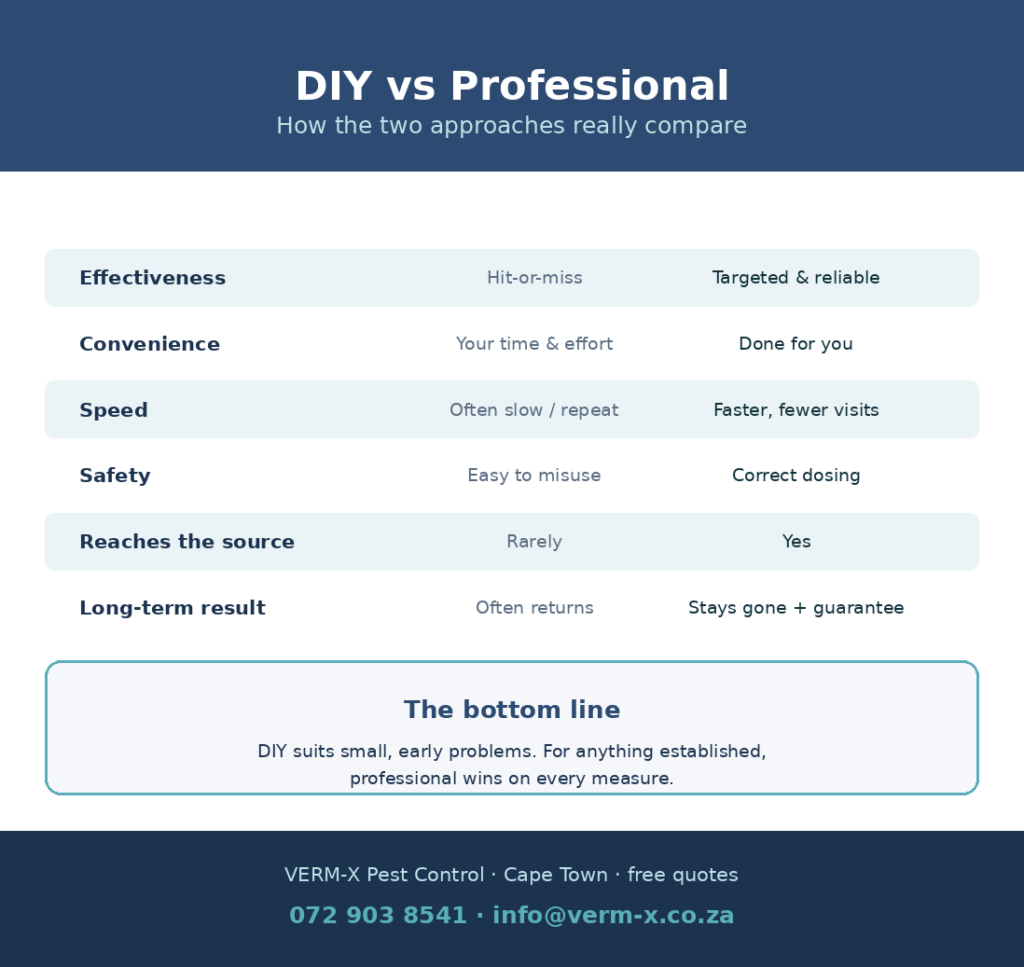
“DIY vs Professional” comparison.
What’s the core difference between DIY and professional pest control?
It comes down to surface versus source. A shop-bought spray is designed to be safe for anyone to use, so it’s general-purpose and works on contact — it kills what it touches. A professional treatment starts with correct identification, then targets where the pests live and breed: behind cabinets, in wall voids, under floors, in roof spaces. One treats the symptom; the other treats the cause. Everything else that follows — effectiveness, speed, how long the result lasts — flows from that single difference.
Which is more effective?
For a small, contained problem, DIY can be perfectly effective — a single ant trail or one mouse is well within reach of a trap or bait. But effectiveness drops sharply as a problem grows. With cockroaches, for example, a surface spray kills the visible insects while the egg cases and the bulk of the colony sit untouched, so numbers bounce back within weeks.
A professional uses registered products at the right concentration, placed where they break the life cycle, often combined with monitoring. That’s why a single professional treatment usually outperforms repeated DIY attempts on the same problem — it’s reaching what you can’t.
Which is more convenient?
This is where people underestimate DIY’s hidden cost. The products are cheap, but the time and effort are yours: researching the right product, applying it correctly, re-treating when it doesn’t hold, moving furniture, and living with the problem while you experiment. Professional pest control is genuinely hands-off — a technician assesses, treats, and advises, and you get on with your life. For busy households and any commercial space, that convenience is a big part of the value.
Which works faster?
DIY can knock down what you see almost instantly, which feels fast — but clearing the actual infestation through DIY often drags on over weeks of repeat treatments. Professional treatment is usually quicker to a real resolution because it targets the source the first time, and many companies, including our Cape Town pest control team, offer same-day call-outs for urgent problems.
Which is safer?
Both can be safe — and both can be misused. The risk with DIY is dosage and placement: over-applying a product, spraying near food or pets, or using something not suited to the pest. A trained technician knows which registered products to use, at what concentration, and how to keep treatments away from children, pets and food-prep areas. If you have a baby, pets or anyone with respiratory sensitivities at home, that expertise matters.
Which gives longer-lasting results?
This is the clearest gap. Because DIY usually treats the surface, problems tend to return — you’re managing it rather than ending it. Professional treatment aims to clear the source, and reputable operators back it with a guarantee: if the pests return within the cover period, they re-treat at no charge. That combination of source treatment plus guarantee is something no over-the-counter product offers.
So which should you choose?
Use DIY when the problem is small, visible and recent — a stray ant trail, a single fishmoth, one mouse — and as your ongoing prevention routine. Choose a professional when the problem is spreading, recurring, hidden, or involves rodents, cockroaches or termites, and whenever safety is a concern. A quick honest assessment from a professional pest control team in Cape Town will tell you which side of that line you’re on.
Does Cape Town’s climate change the equation?
It does. Our wet winters push rats, cockroaches and ants indoors, turning small problems into established ones quickly — exactly the scenario where DIY falls behind and professional treatment pulls ahead. Coastal damp also keeps fishmoths and mould-feeding pests active year-round. In Cape Town, the “which is better” answer leans professional more often than it would in a drier climate, simply because problems escalate faster here.
Want it sorted properly the first time?
If you’re past the point where a spray will do, VERM-X can help. 14+ years in Cape Town and the Western Cape — certified, registered, same-day emergency call-outs often available, and a guarantee behind the work. Free quotes, no obligation.
Or email info@verm-x.co.za — we cover greater Cape Town and the whole Western Cape.
Frequently Asked Questions
Is professional pest control really more effective than DIY?
For established problems, yes. DIY treats the surface, while professionals treat the hidden source and breeding cycle, so a single professional treatment often outperforms repeated DIY attempts. For tiny, contained problems, DIY can be equally effective.
What can DIY pest control handle on its own?
Small, early, visible problems — a single ant trail, one or two fishmoths, a lone mouse — plus ongoing prevention like sealing gaps and keeping food stored. Beyond that, results tend to be temporary.
Why do pests come back after I treat them myself?
Because most DIY products kill what’s on the surface but miss the nest, eggs or hidden population. The survivors breed and the problem returns. Source treatment is what stops the cycle.
Is professional pest control safe around children and pets?
Yes, when done by a certified technician who uses registered products at the correct dosage and keeps treatments away from food, children and pets. Correct application is exactly where professional handling beats DIY on safety.
Which is more convenient overall?
Professional, for anything beyond a minor problem. DIY’s products are cheap, but the time, repeat treatments and trial-and-error are yours. A professional handles it start to finish.