
How Much Does a Licensed Exterminator Make? (Is It a Good Career?)
Quick Answer
In South Africa, a pest control technician typically earns around R6,000–R10,000 a month starting out, rising to R10,000–R18,000 with experience, and R18,000–R30,000+ for senior or specialised (like fumigation) roles. Business owners can earn considerably more. It’s a stable, in-demand trade with a low barrier to entry and clear room to grow — a genuinely good career for practical, reliable people.
Pest control rarely makes anyone’s list of “dream jobs,” but it’s a steady, recession-resistant trade that people underestimate. Pests don’t stop appearing when the economy dips, so the work is consistent — and for someone who likes hands-on problem-solving and dealing with people, it can be a rewarding career with a real path to running your own business. Here’s an honest look at the money and the reality.
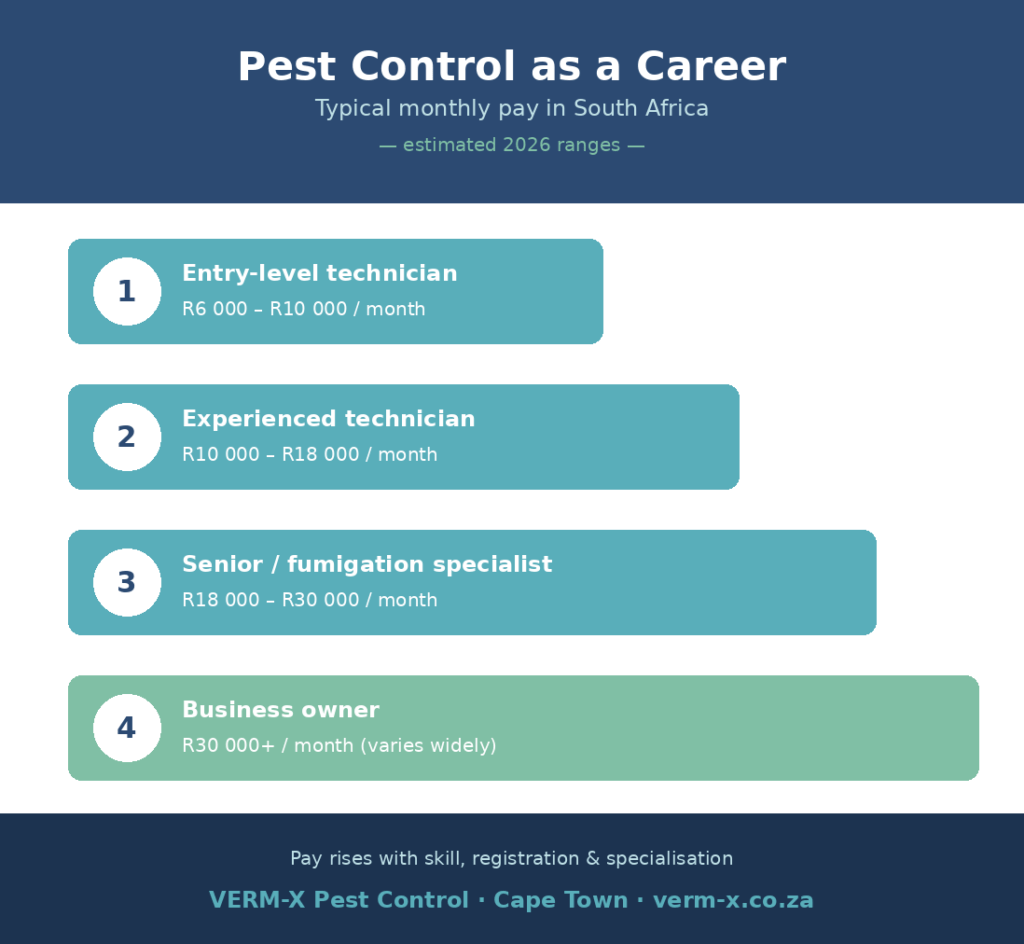
“Pest Control as a Career” salary ladder
How much does a pest control technician earn in South Africa?
Earnings depend heavily on experience, registration and whether you specialise. As a rough 2026 guide:
- Entry-level technician: around R6,000–R10,000 per month
- Experienced technician: roughly R10,000–R18,000 per month
- Senior technician or fumigation specialist: about R18,000–R30,000 per month
- Business owner: highly variable — often R30,000+ once established
These are estimates and vary by employer, region and workload. Many technicians also earn more through commission, overtime, call-out bonuses or a company vehicle and fuel. The ceiling really lifts when you become a registered operator handling specialised work, or when you start your own company.
What affects how much you earn?
- Registration and qualifications. Being a registered pest control operator opens up higher-value, specialised work.
- Specialisation. Fumigation, termite work and commercial contracts pay more than basic residential spraying.
- Experience and reputation. Reliable technicians who solve problems the first time become valuable quickly.
- Employer vs self-employed. Employees earn a steadier wage; owners take on risk for a higher ceiling.
- Location and demand. Busy metros with lots of homes and businesses — like Cape Town — offer more consistent work.
Is pest control a good career?
For the right person, yes. The upsides are real:
- Steady demand. Pests are a year-round problem, so the work doesn’t dry up.
- Low barrier to entry. You don’t need a university degree — training, registration and a good attitude get you started.
- Variety. No two days or properties are the same, and you’re out and about rather than stuck at a desk.
- A clear path up. From technician to specialist to business owner, the progression is well-defined.
- People-facing. If you enjoy helping customers solve a stressful problem, it’s satisfying work.
What’s the downside?
It’s fair to be honest about the trade-offs. The work is physical — you’re on your feet, in roof spaces, under floors and in tight spots. You’ll deal with unpleasant sights and smells, and handle chemicals safely, which demands care and discipline. Early-career pay is modest, and some work is seasonal or weather-dependent. It also carries